
On this page
- Signs replacement beats repair
- Why do so many local homes need upsizing?
- What does a replacement involve?
- What does replacement cost?
- Pairing new gutters with a new roof
- What about HOA colors?
- Should downspouts be replaced too?
- What should you check when it is done?
- Picking the season
- Adding guards at the same time
- Testing the buried lines
- Avoiding the same mistake twice
- The warranty
- Staging the work
- Builder warranties
- Rain mid-job
- Downspouts go too
- What to check on handover day
Signs replacement beats repair
Dial (470) 326-1690 to reach an independent local crew who replaces gutters around Buford.
| Sign | What it means |
|---|---|
| Leaks at many joints | Sealant and seams are failing everywhere |
| Sags along the whole house | Fixings have failed, not one hanger |
| Spills in every downpour | Gutters too small for the roof |
| Thin, dented metal | Builder-grade .025 or .027-inch |
| Rust on steel | End of life |
| Soft fascia behind | Water has been getting behind for years |
| Roof replacement planned | Gutters may come off anyway |
Why do so many local homes need upsizing?
Because many were built with the minimum. Buford's population rose from 12,225 in 2010 to 17,144 in 2020, and big subdivisions such as Hamilton Mill went up between 1995 and 2008. Builder gutters on homes of that era are often 5-inch with a downspout at each corner. On a large two-storey roof, that is not enough for local rain.
NOAA's atlas gives a 10-year, five-minute intensity near Buford of about 7.94 inches an hour. Plug that into This Old House's formula and a 5-inch K-style run tops out near 630 square feet of 6/12 roof; a 6-inch, near 910. Replacing like for like on an undersized system keeps the same overflow. See 6-inch gutters.
What does a replacement involve?
- Remove the old gutters, downspouts and failed fixings.
- Inspect the fascia and replace soft boards.
- Check the drip edge and fit or extend it so it laps into the gutter.
- Size each run from roof area, pitch and valleys.
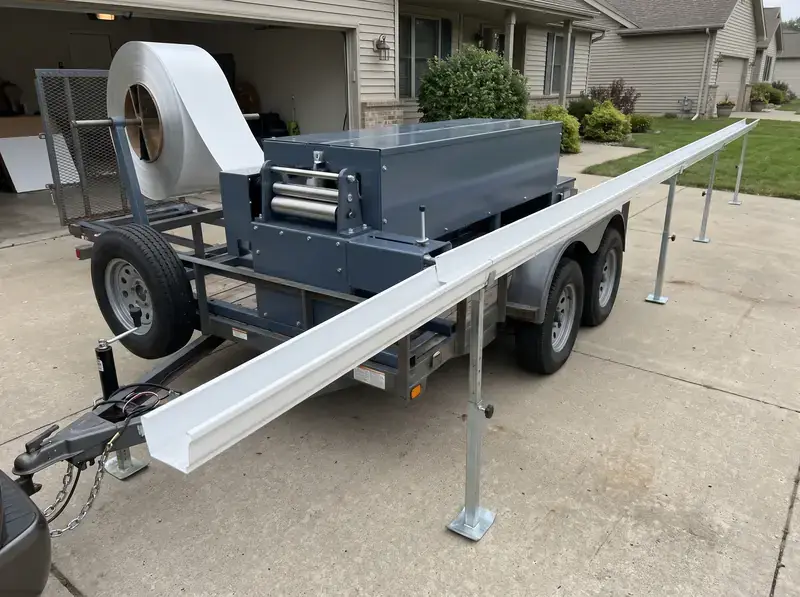
- Form seamless runs on site in the chosen metal and color.
- Hang on hidden hangers into sound wood with a steady fall.
- Fit downspouts, adding more on long runs and below valleys.
- Route discharge away from basements, foundations and neighbors.
- Test with water and clear the site.
What does replacement cost?
Angi's cost data puts installed seamless aluminum at $9 to $14 per foot in 5-inch and $11 to $17 in 6-inch. Removal, fascia repair, extra downspouts, guards and buried lines add to that. See the Buford cost guide.
Pairing new gutters with a new roof
Often. Roofers frequently remove gutters to replace the drip edge, and fascia is easiest to repair with both off. Ask both contractors how they will coordinate, who handles the drip edge, and how soon the gutters can go back up so the house is not without them in a storm.
What about HOA colors?
Coil stock comes pre-painted in a broad palette. In HOA neighborhoods, check the approved colors and any product rules before ordering. A like-for-like color is rarely an issue.
Should downspouts be replaced too?
Usually. Old downspouts are often 2x3-inch and dented, and new outlets rarely line up with old ones. Upsizing to 3x4-inch carries more water and clogs less under pines.
What should you check when it is done?
- No water standing in any run after a hose test.
- Corners and outlets sealed neatly from inside.
- Brackets at even intervals, every screw in solid wood.
- Downspouts strapped firmly and discharging where agreed.
- Flashing at the roof edge tucked down into the trough.
- Old gutters and offcuts removed.
Picking the season
Late winter and early autumn suit most homes: ahead of pollen and summer storms, or ahead of the leaf fall. Dry spells help carpentry and let sealant cure. If gutters fail in high summer, a contractor can patch and book the full job for a dry week.
Adding guards at the same time
Under pines, it often makes sense: one visit, and a guard cut to the exact gutter. Get it priced as its own line.
Testing the buried lines
If downspouts disappear into the ground, run water through each before the new gutters go up. A silted, crushed or ribbed line will back the new system up in its first storm. Swapping it for smooth pipe with clean-outs is cheap insurance.
Avoiding the same mistake twice
Ask how every run was sized. Roof area, pitch, valleys and NOAA's 10-year, five-minute rate of about 7.94 inches an hour near Buford should all come up. A quote with 5-inch throughout on a large two-storey deserves a follow-up question.
The warranty
Two parts: the contractor's workmanship cover for a stated period, and the manufacturer's on metal and finish. Ask for both on paper, with the exclusions spelled out.
Staging the work
Some owners do the rear runs first, where spills do the most damage, and the front later. Ask for the same color and profile so the two halves look like one system.
Builder warranties
These typically expire long before the gutters do. New ones come with replacement; file the paperwork.
Rain mid-job
Crews avoid starting in forecast rain. If a storm turns up halfway through, they should leave temporary protection so water does not pour onto the foundation where gutters are down.
Downspouts go too
Old downspouts are often small and dented, and new outlets rarely line up with old positions. Replacing them at the same time costs little more.
What to check on handover day
Walk round with the crew. Every run should be tight to the board with no daylight behind it, joints should be sealed, downspouts strapped, extensions pointing away from the walls, and the old gutters and scraps gone. Run a hose at the high end of a couple of runs and watch the water reach each outlet.