
On this page
Watch where and when it spills
The pattern is the diagnosis. Call (470) 326-1690 and an independent contractor around Buford can test the system and fix the actual cause.
| What you notice | Probable cause | What usually solves it |
|---|---|---|
| Spills even in a light shower | Outlet or downspout clogged | Clear it; flush any buried line |
| Sheets over the whole length in a cloudburst | Gutter undersized for the roof | Go to 6-inch, or add downspouts |
| Pours off one corner | Valley above that corner | Splash guard, outlet near the corner, larger run |
| Spills mid-run | A dip has formed | Re-hang to an even slope |
| Water leaps clear of the gutter | Steep or metal roof, gutter set high | Lower the gutter, add a splash guard |
| Pours over the top of a guard | Mesh filmed with pollen | Brush or rinse |
Is the gutter simply too small?
On many two-storey homes around Buford, yes. NOAA's precipitation atlas puts a 10-year, five-minute burst near Buford at about 7.94 inches an hour. Run that through the This Old House sizing method and a 5-inch K-style run can serve about 630 square feet of roof at a 6/12 pitch; a 6-inch, about 910. A typical rear roof plane on a 1990s or 2000s subdivision house is larger than the first figure. See 6-inch gutters.
The usual blockers
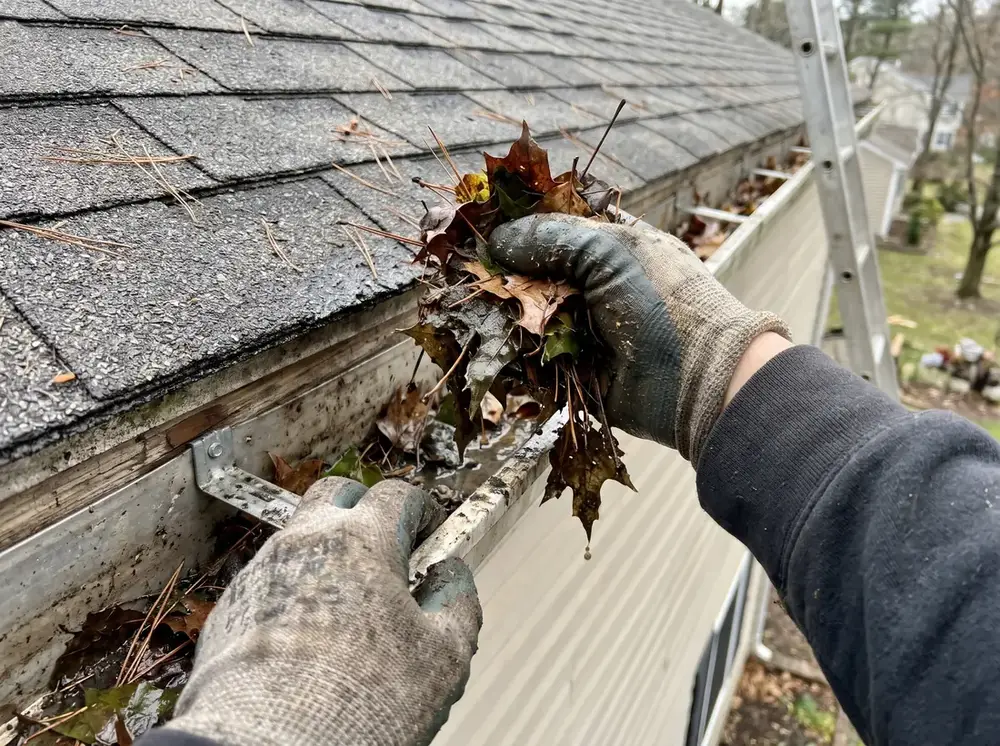
- Pine straw, which lies across an outlet and catches everything after it.
- Oak, maple and tulip poplar leaves each autumn.
- Sweetgum balls and acorns, which wedge in downspout elbows.
- Spring pollen, which settles as a paste that binds the rest.
- Silt in a buried line, backing water up into the gutter.
Valleys
Two roof slopes meet in a valley and send their water, straw and leaves down a single channel to one point on the gutter. In a thunderstorm that stream hits the gutter fast enough to jump the front lip. A small metal splash guard on the lip, an outlet placed close to the corner, and a 6-inch section there are the standard answers.
Where the spilled water goes
Straight down, along the foundation, onto the Piedmont's Cecil soils and their slow-draining red clay subsoil. On a basement house, that is the wall you least want wet. Overflow also streaks brick, softens fascia, and washes mulch out of beds.
Testing without a storm
A hose in the high end of each run shows whether outlets and downspouts pass water. It cannot imitate a cloudburst or a valley in full flow, so the next time a hard storm rolls through, stand at a window and note which corners and runs let go. That note is worth more to a contractor than any measurement.
Slope
A run hung dead level, or tilted the wrong way, holds water and spills. A steady fall toward each outlet cures it.
Timing
Fix it in spring. Summer thunderstorms will find every weak run, and a gutter that spills in April will spill harder in July.
Valley fixes compared
| Fix | Effect |
|---|---|
| Splash guard | Catches the valley's stream at the front lip |
| Outlet near the corner | Drains the rush before it backs up |
| 6-inch section | More volume and a bigger outlet |
| Valley diverter | Spreads the flow along the trough |
| Swept valley | Stops straw riding the water over the edge |
Water overshooting the gutter
On steep or metal roofs in a downpour, water can leave the roof fast enough to clear the gutter. Lowering the gutter a little or adding a splash guard keeps it in.
Spills and termites
Overflow keeps the soil at the foundation wet, and termites follow moisture. UGA Extension advises gutters that drain away from the house.
Ice on steps
Water spilling onto steps and walks can freeze on cold nights. Another reason to fix overflow before winter.